


The Hero’s Journey
Table of Contents
A very interesting study by the American professor Joseph Campbell, who published as a book in 1949 under the name “A Thousand Faces” or “The Monomyth” could also be considered as an official link between cinema and literature using the formula of unfolding history.
The Monomyth is a great link between the literary world and the world of cinema as a formal exploration and application in the screenplay formula in later films, as well as its obligatory application in the screen adaptation of novels using this formula.
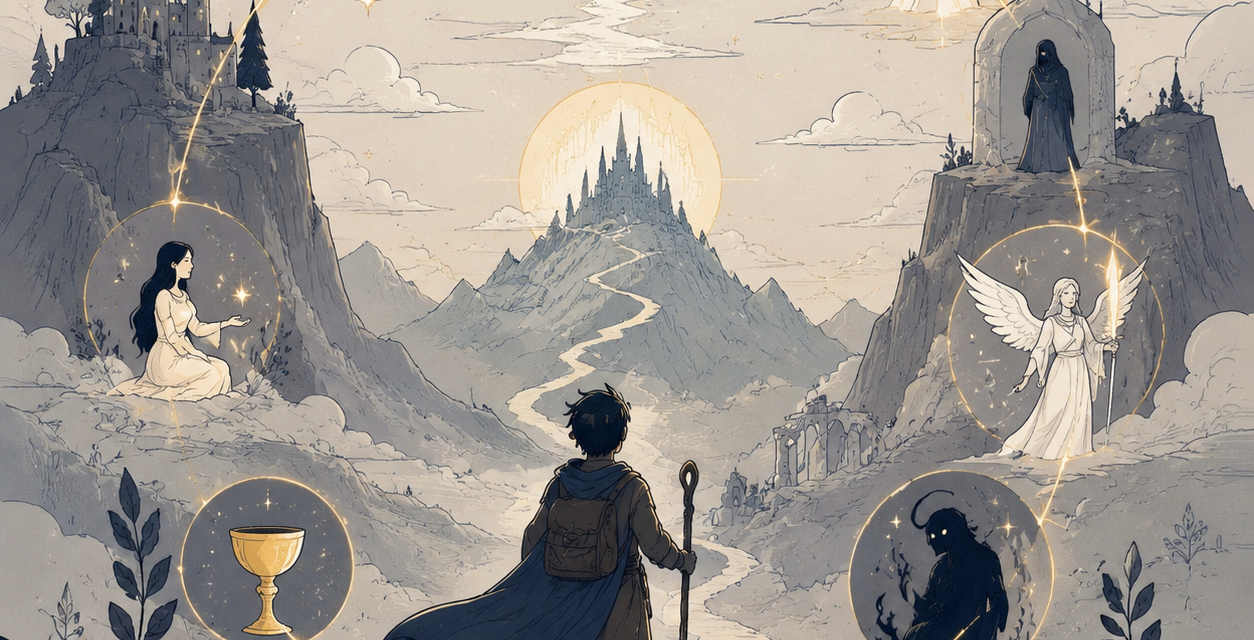
The work deals with “The Journey of the Hero” / “The Monomyth”, or how through different myths one can observe almost the same structure of storytelling.
His work is foundation to other theorists (David Lemming, Phil Cozinho, Christopher Vogler, Dan Harmon), and develops aspects of consideration in 17 stages dividing it into three main sections (Departure, Initiation, Return) just as in modern times movie are being studied at film schools (actions I, II, III – connection, development, denouement).
Campbell does not claim that all stages are present for all mythological narratives, but does state that this is the main structure by which, depending on the variations of the parts they are constructed.
Hero’s Journey Steps
The structure looks like this:
Departure
Invitation to travel – the character is in a normal domestic situation and is summoned to travel;
Call Rejection – The character rejects the call for a domestic, religious, cultural or other reason;
Supernatural Aid – When the hero is ready, the mentor comes with a magical artifact, a talisman, a tip, or body and mind training;
Crossing the threshold – this is when the hero crosses the threshold of his past life and delves into adventure and the unknown;
The Whale’s Belly (a reference to the myth of biblical Jonah engulfed by the great Whale, bel.a.) – the final phase of the separation of the character from his past life, can be presented to him as a small ordeal to bring him back. but undergo some kind of metamorphosis.
Initiation
The road to trials – here the hero is already confronted with a series of trials, of which he usually fails at one and more than one, but eventually overcomes them;
Deity encounter – the hero receives something that will help him in the future / the hero’s soul rejoices with the divinity of the world;
Woman as temptation – not necessarily a woman, but a representation of the material world that tries to entice the character to stray from the adventure;
Redemption in front of the father (father’s figure) – in many stories he is a male figure, but not necessarily – the representation that has the greatest power over the hero, clash and redemption;
Apotheosis – the enlightenment and the attainment of great wisdom or knowledge, by which the character internally prepares for the most difficult battle in his spiritual journey;
Grace – the holy grail, the manna of heaven, the supreme goal – the achievement of the hero he was preparing for, the end of the journey he was preparing for, and all the previous steps gave him less power to to achieve it;
Return
Refusal of Return – Conquered by Grace, the hero does not want to return in order to carry it away from his brothers / people;
Magical take off – sometimes the hero must return with the Grace, which is often guarded by jealous gods;
Salvation from external forces – when a hero needs help to complete his task, his companions / friends / allies / enemies intervene in the story and in the completion of the task;
Crossing the threshold of return – the trick is to bring the accumulated wisdom from the journey into daily life, and if possible to share it with the rest of the world;
Master of the two worlds – here the hero becomes a master of the spiritual and material world, through all that has happened so far and has made the correct lessons;
Freedom for Life – Mastery leads to freedom to live and freedom from the fear of death. This is even referred to as “living in the now” – neither in anticipation of the future nor in the regret of the past.

Examples of Hero’s Journey in Cinema
One of the biggest phenomena in the movie “Star Wars” is based on the Monomyth. George Lucas himself mentions in “A Fire in the Mind” (a biography for Campbell):
After “American Graffiti” I came to the conclusion that it is valuable for me to set standards, not to show people the world as it is … around the time of this realization … it occurred to me that there is really no modern use of mythology. .. Western is perhaps the last American fairy tale to tell of our values. And after the Westerns disappeared, nothing took its place. We were getting into science fiction in literature … so then I started doing more research into fairy tales, folklore and mythology and started reading Joe’s books. I hadn’t read any of Joe’s books before … It was very ominous because as I read “The Hero with Thousands Faces”, I began to realize that my first Star Wars project had classic motifs … So I changed my next draft according to what I learned about classic motifs and made it a little more consistent …
Other famous stories include Jesus Christ, Gautama Buddha, “The Lord of the Rings,” “The Epic of Gilgamesh”, “Beowulf“, “Odyssey”, “Iliad”, “Harry Potter” and many, many more.


